

Why Dining Etiquette Matters More Than You Think
Picture this: you’re sitting at a beautifully laid table in Tokyo, and you’ve just stuck your chopsticks upright into your bowl of rice. To you, it’s a harmless gesture. To everyone around you, it’s a symbol deeply associated with funeral rites. The table goes quiet. Faces shift. Nobody says anything, but something has changed.
This kind of moment happens to travellers more often than they realise — not out of disrespect, but simply out of ignorance. Dining is one of the most intimate and culturally loaded experiences a human being can have. The way we eat, what we eat, how we hold our utensils, whether we slurp, whether we finish our plate — all of it carries meaning that varies dramatically from one country to the next.
Understanding the cultural etiquette of dining abroad isn’t about memorising a rulebook. It’s about showing up with genuine curiosity and enough awareness to avoid causing unintentional offence. This guide covers the essential dining customs from around the world, broken down by region, so you can eat your way across the globe with confidence and grace.
Europe: Where Formality and Relaxed Dining Collide
Europe is far from a monolith when it comes to dining customs. What’s perfectly acceptable in Spain might raise eyebrows in Germany, and the French have their own very particular ideas about how a meal should unfold.
Table Manners in Europe vs the USA
One of the most commonly searched questions about international dining is the difference between European and American table manners — and it’s a fair one, because the contrasts are surprisingly significant.
In the United States, it’s common to cut food and then switch the fork to the right hand to eat — a style sometimes called the “American zigzag.” In most of Europe, the fork stays in the left hand throughout the meal, with the knife remaining in the right. This isn’t just a stylistic difference; many Europeans find the constant switching slightly awkward to observe, though few would say anything.
Americans also tend to have a more casual approach to mealtimes. In Europe — particularly in France, Italy, and Spain — dining is a drawn-out, social affair. Rushing through a meal is considered rather rude. In France, asking for the bill before you’re ready to leave is seen as pushy; you’re expected to sit, converse, and let the evening breathe.
Other key European dining customs include:
- France: Keep your hands on the table (not your elbows, just your wrists and hands). Bread is placed directly on the table, not on a side plate.
- Germany: It’s polite to wait until everyone is served before eating. Saying “Guten Appetit” before beginning is standard practice.
- Spain: Dinner typically doesn’t start until 9 or 10pm. Arriving early to a dinner invitation is actually considered impolite.
- Italy: Cappuccino is a morning drink only. Ordering one after a meal will almost certainly earn you a puzzled look from your waiter.
- United Kingdom: Queuing for a table, keeping your voice at a moderate level, and thanking staff frequently are all expected behaviours.
Is It Rude to Not Finish Your Plate in Italy?
This question comes up often, and the answer is nuanced. In Italy, leaving food on your plate isn’t considered deeply offensive, but finishing your meal is generally taken as a compliment to the cook — especially in someone’s home. If you’re dining with an Italian family and leave a full plate, your host may worry the food wasn’t to your liking and insist on preparing something else. It’s worth eating what you can and expressing genuine appreciation regardless.

Asia: Rich Traditions and Meaningful Rituals
Asian dining cultures are among the most nuanced in the world, often layered with historical, spiritual, and social significance. A small gesture at the table can carry enormous weight.
Japan: Precision, Respect, and Ritual
Japanese dining etiquette is detailed and deeply meaningful. Beyond the chopstick rule mentioned earlier, there are several customs worth knowing:
- Say “Itadakimasu” before eating — it’s an expression of gratitude for the meal.
- Slurping noodles is not only acceptable but considered a sign that you’re enjoying the food.
- Pouring your own drink is considered poor form; pour for others first, and they’ll return the favour.
- Tipping is not practised in Japan and can even be considered rude or confusing.
- Never pass food directly from chopstick to chopstick — this mimics a funeral ritual and is deeply taboo.
China: Communal Feasting and the Lazy Susan
Chinese dining is communal by nature. Dishes are shared across the table rather than individually plated, and the lazy Susan at the centre of many Chinese restaurant tables exists precisely to facilitate this sharing. It’s polite to serve food to others before helping yourself, particularly to elders at the table.
Interestingly, in China — particularly in older or more traditional contexts — it is considered polite to leave a small amount of food on your plate. Finishing everything might suggest the host didn’t provide enough food. This is essentially the opposite of customs in many Western countries, which is a good reminder that there are no universal rules.
India: The Right Hand Rule and Beyond
Across much of India, eating with your hands is not only acceptable but preferred for certain dishes. However, always use your right hand — the left hand is considered unclean in many Indian traditions. This applies whether you’re scooping up dal with roti or enjoying a banana-leaf meal in Tamil Nadu.
In India, it’s also common for a host to insist you eat more, often multiple times. Refusing firmly but politely after a first refusal is generally understood, but be prepared for some gentle persistence — it’s a genuine expression of hospitality.
The Middle East and Africa: Hospitality as a Core Value
In much of the Middle East and North Africa, hospitality is a cornerstone of culture — and the dining table is where that hospitality is most visibly expressed. Refusing food or drink when offered can sometimes be interpreted as disrespectful, so it’s worth accepting at least a small portion, even if you decline more afterwards.
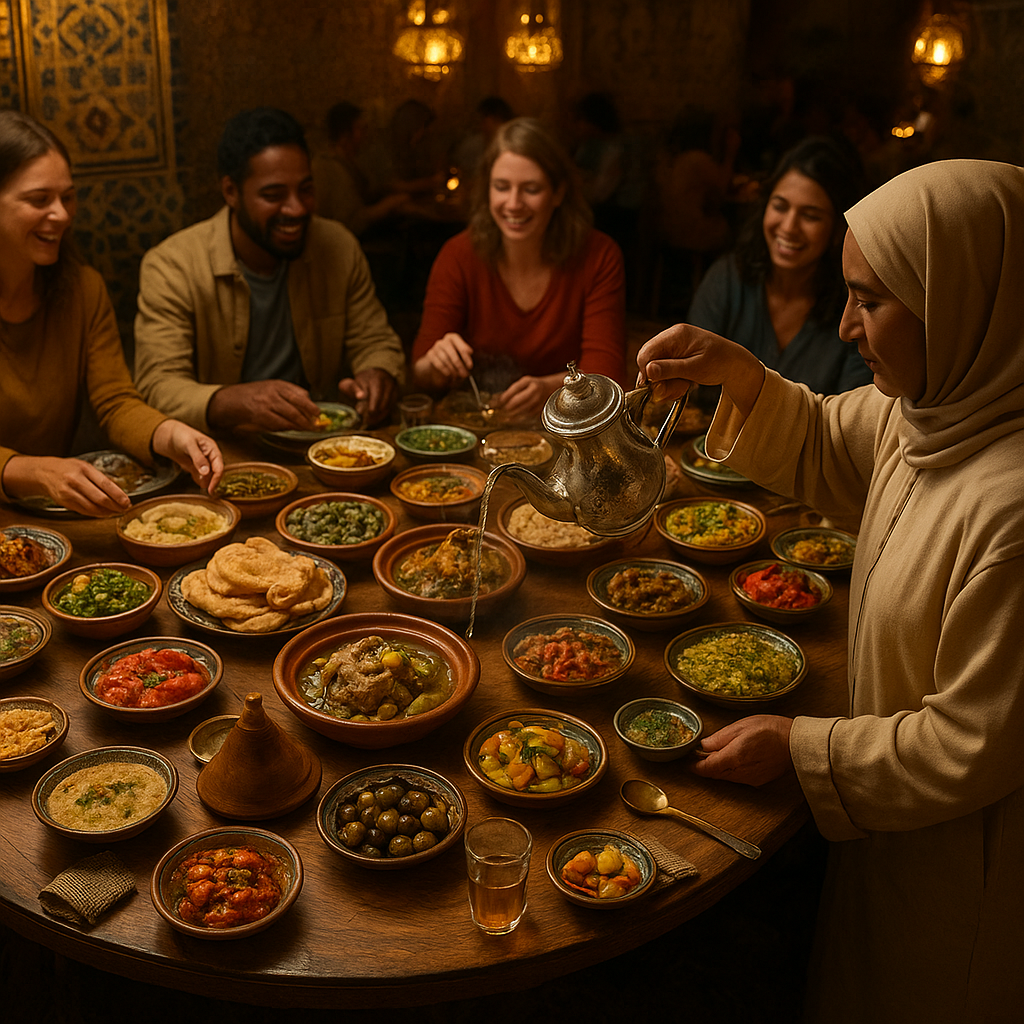
In countries like Morocco, communal eating from a shared tagine or couscous dish is standard. Use bread to scoop food, always with your right hand. In many Arab households, it’s customary to wash hands before and after a meal, and a bowl of water may be brought to the table for this purpose.
Across sub-Saharan Africa, customs vary enormously by country and community, but a few threads are common: respect for elders at the table, gratitude expressed to the host, and the value placed on eating together as a social act rather than a mere necessity.
What Country Is It Rude to Not Finish Your Food In?
This is one of the most frequently asked questions about global dining etiquette, and the answer varies more than most people expect. Here’s a quick breakdown:
- Japan: Finishing your meal entirely is a sign of appreciation and is expected. Wasting food is considered disrespectful.
- South Korea: Similar to Japan — cleaning your plate shows you enjoyed the meal.
- China: Leaving a little food behind can signal that you’ve been well-fed. Finishing everything might imply you weren’t given enough.
- India: Finishing your food is generally considered polite, though customs vary by region and household.
- Ethiopia: Leaving food can be seen as wasteful, though finishing too quickly might suggest you weren’t given enough.
- Philippines: Finishing everything on your plate is typically seen as a compliment to the host.
The lesson here is simple: before dining in someone’s home in an unfamiliar culture, a little research goes a long way. The same spirit of approaching unfamiliar situations with curiosity that serves travellers in challenging moments abroad applies equally well at the dinner table.
The 7 Core Etiquette Rules That Apply Almost Everywhere
While customs differ wildly across cultures, there are a handful of principles that hold true in most dining contexts around the world. These serve as a useful baseline when you’re uncertain:
- 1. Wait to be seated. In many cultures, guests are guided to their seats by a host. Sitting down before being invited can be seen as presumptuous.
- 2. Wait until everyone is served before eating. This is standard in most of Europe, East Asia, and the Middle East.
- 3. Keep mobile phones away. Scrolling during a shared meal is considered rude in almost every culture.
- 4. Chew with your mouth closed. With the notable exception of noodle-slurping in Japan and some other East Asian contexts, eating quietly is universally appreciated.
- 5. Express gratitude. Whether it’s “Itadakimasu” in Japan, “Bon appétit” in France, or a simple thank-you in English, acknowledging the meal matters.
- 6. Follow the lead of your host. When in doubt, watch what others around you are doing before diving in.
- 7. Never waste food unnecessarily. Across virtually every culture, wasting food is frowned upon. Serve yourself what you’ll actually eat.
Practical Tips for Navigating Unfamiliar Dining Customs
Beyond knowing specific rules, there are a few broader habits that will serve any traveller well at the dining table:
- Do a little research before you arrive. A quick search on the dining customs of your destination country takes minutes and can save you from significant embarrassment.
- Ask questions with genuine curiosity. If you’re unsure whether to use your hands, which utensil to pick up first, or whether to pour your own drink, asking openly and respectfully is almost always appreciated.
- Observe before acting. In a new dining environment, spend a moment watching how others behave before launching in. This is especially useful in communal dining settings.
- Be mindful of dietary declarations. In some cultures, announcing dietary restrictions can be logistically complicated for hosts. Try to communicate any serious restrictions in advance rather than at the table. Building mindful habits around food and daily routines at home can make navigating these moments abroad feel far more natural.
- Learn a few words in the local language. Knowing how to say “thank you” and “delicious” in the local tongue is one of the most charming things a traveller can do at the dinner table.
In Summary: Eat Curiously, Eat Respectfully
Dining abroad is one of travel’s greatest pleasures — and one of its most delicate social minefields. From the communal platters of Morocco to the precise rituals of a Japanese kaiseki meal, the world’s dining tables tell you everything about what a culture values: family, generosity, ceremony, simplicity, or abundance.
The key takeaways are worth keeping close. Research the customs of your destination before you arrive. Observe before you act. Follow your host’s lead. Finish your plate in Japan and South Korea; leave a little in China. Use your right hand in India and across much of the Middle East. And wherever you are, express genuine gratitude — because that, at least, translates across every language and culture on earth.
Travel changes the way we see the world, and sometimes the most profound shifts in perspective happen not at a famous landmark, but around a dinner table, sharing a meal with people whose customs and traditions are entirely different from our own.